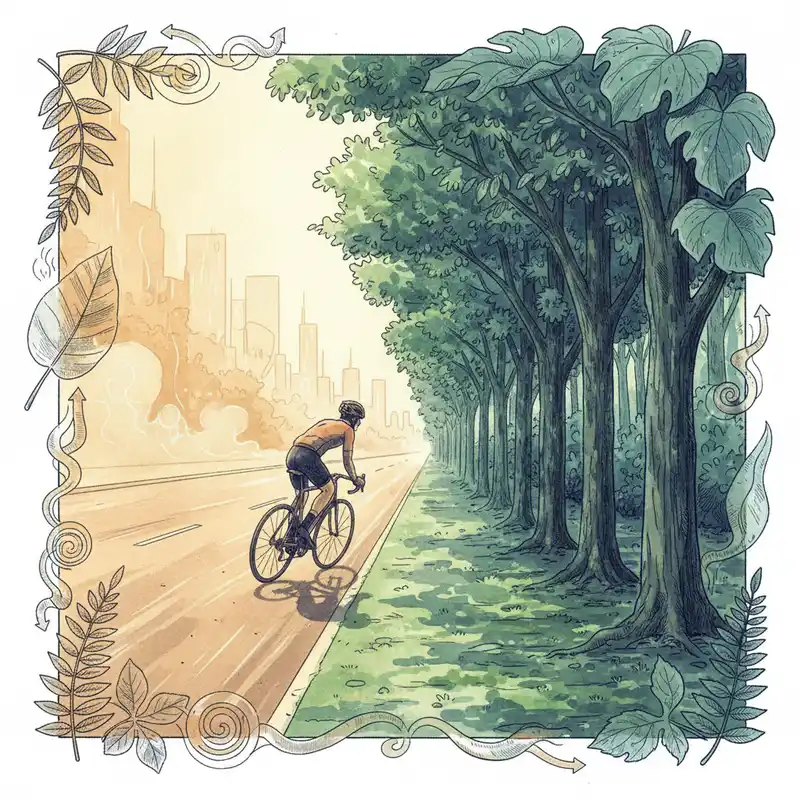
Asphalt acts like a thermal sponge. It traps solar radiation into sub-base aggregate, radiating secondary infrared waves right into strollers and pet paws.
Cities are thermal mosaics. Walk the cool lines.
On a 32°C (90°F) afternoon, dark impervious asphalt absorbs up to 95% of incoming solar radiation, baking surface temperatures past 50°C. Two streets over, a mature oak and london plane canopy acts as a biological parasol, transpiring water vapor and holding surface skin temperatures down by 18°C to 22°C.
The Cool Route Quest: Transit Sector 7
Click street segments to re-route Scout's journey from Central Station to the Riverside Library. Toggle canopy trees and cool roofs to observe live surface temperatures, mean radiant heat, and sweat-stress indices.
Surface Showdown: Under Direct 32°C (90°F) Sunlight
Real physical measurements collected with infrared thermography across identical ambient sunshine at solar noon.
12°C cooler than asphalt due to higher reflectivity, but reflects harsh blinding glare upward onto pedestrian faces without plant cover.
Plants pump water from root depth and evaporate it through stomata. This evaporative latent heat flux keeps the turf noticeably cooler than the ambient air.
Leaves stop radiant photons 8 meters in the sky before they ever touch the ground, cooling both the air column and ground below simultaneously.
Heat Basics: Why Your City Traps The Sun
The physics of the Urban Heat Island (UHI) boils down to four distinct mechanisms.
The Albedo Trap
Albedo is reflectivity from 0 (total absorber) to 1 (pure mirror). Dark roofing and fresh black asphalt absorb 90% of solar radiation. Swapping to high-albedo coatings reflects light directly back to space before it transforms into trapped thermal energy.
The Canyon Geometry
Tall parallel buildings create an "urban canyon." Instead of re-radiating heat into the open sky at dusk, buildings bounce infrared rays back and forth between concrete walls, preventing nighttime cooling and prolonging heat waves.
Loss of Evapotranspiration
Natural forests and grasslands convert up to 70% of absorbed solar energy into latent heat by evaporating water. Impervious concrete seals off water, converting almost all absorbed energy into sensible heat—the heat you feel burning your face.
Anthropogenic Heat Discharge
Every air conditioner cooling an apartment discharges condensed hot exhaust directly onto the sidewalk below. In dense downtowns during peaks, HVAC rejected heat can add an extra 1.5°C to 2.5°C to street-level microclimates.
Scout's Expedition Log & Field Notes
Real ground-truthed readings logged by muses and field researchers using IR cameras and portable wet-bulb thermometers.
4th Street Market Crossing
Crossing from the parking lot asphalt to the sycamore grove felt like walking into an air-conditioned tent. Thermal imaging showed the curb stone alone reached 44°C.
Municipal Fleet Maintenance Shed
Half the roof was recoated with high-solids white silicone coating (SRI 110). Standing directly over the coated section, downward radiative load felt nearly nonexistent.
North River Towpath Walkway
Even with high humidity, air moving across water drops ambient temperature within a 15-meter buffer zone. Combining open water with weeping willows provided highest comfort index of the quest.